
The short answer Dust mite allergy is the most common indoor allergy found in UAE allergy studies. Roughly 4 in 10 people tested for allergies in the UAE react to house dust mites. Dubai’s coastal humidity and air-conditioned homes (kept between 20 and 30°C) suit mites very well.
It has nothing to do with how clean your home is. Proper testing, indoor humidity below 50%, 60°C washes and mite-proof bedding are the practical places to start.
Estimated reading time: 14 minutes
When most people hear the words “dust mites”, they picture a dirty house.
They see one of those scary magnified photos online and immediately think, “My home must not be clean enough.”
I hear this all the time, especially from mothers. And I always say the same thing.
Dust mite allergy has nothing to do with how clean your home is.
Dust mites are in every home. Rich or poor, villa or apartment, Emirates Hills or International City. They live on our beds, our mattresses, our pillows, our sofas and our curtains.
So please, put the guilt down. Let me explain what’s really going on, and why Dubai suits these tiny creatures so well.
So please, put the guilt down. Let me explain what’s really going on, and why Dubai suits these tiny creatures so well.
What Exactly Is a Dust Mite?
You can’t see a dust mite with the naked eye. They’re about 0.2 to 0.3 mm long. Google the pictures if you’re curious. Just maybe not right before bed.
The scientific name tells you everything: Dermatophagoides. “Derma” means skin, “phagoides” means eater. Quite literally, a skin eater.
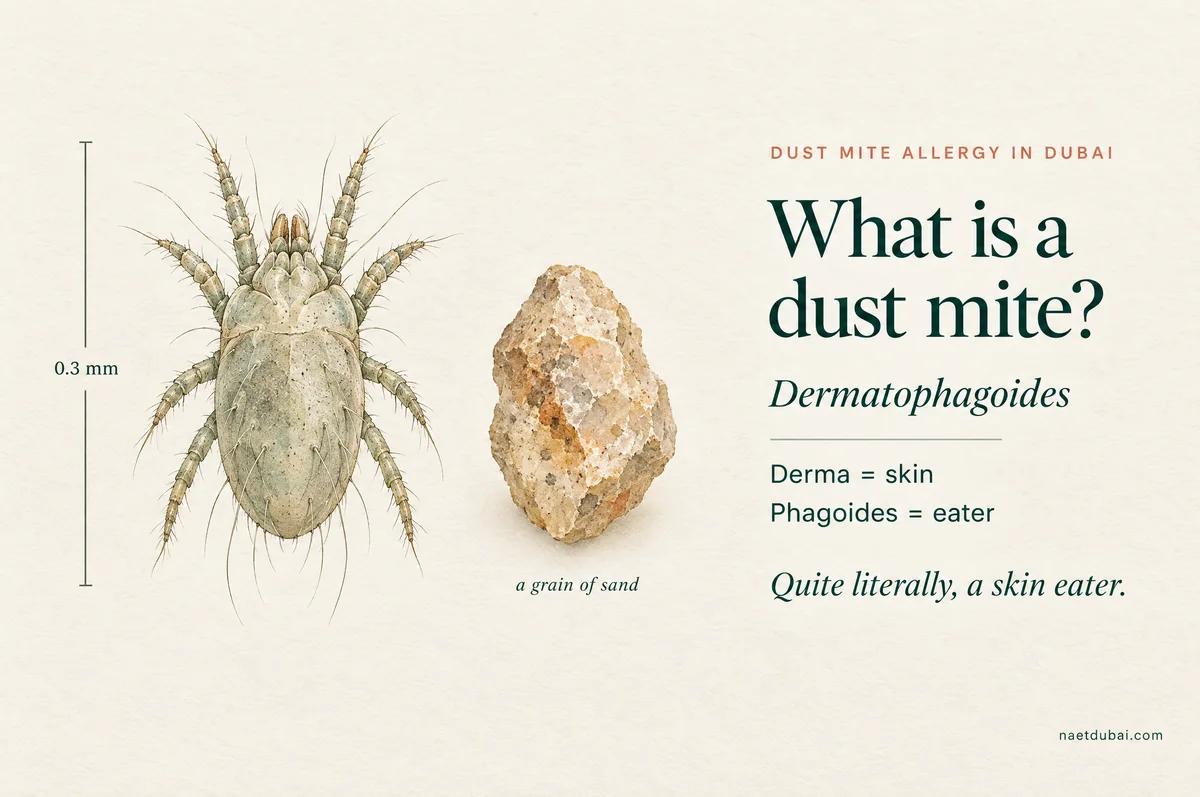
Our skin is constantly shedding. That dead skin is protein, and it’s their food. They don’t bite. They simply live where we shed the most, which is where we sleep and sit.
Here’s the interesting part. Dust mites don’t drink water. They absorb moisture straight from the air around them.
And that is exactly why Dubai suits them so well.
Why Dubai Is Dust Mite Heaven (Even Though We Live in a Desert)
People are often surprised. “Tom, we live in a desert. How can we have a dust mite problem?”
The answer is two words: humidity and air conditioning.
The temperature they love is the temperature we live in
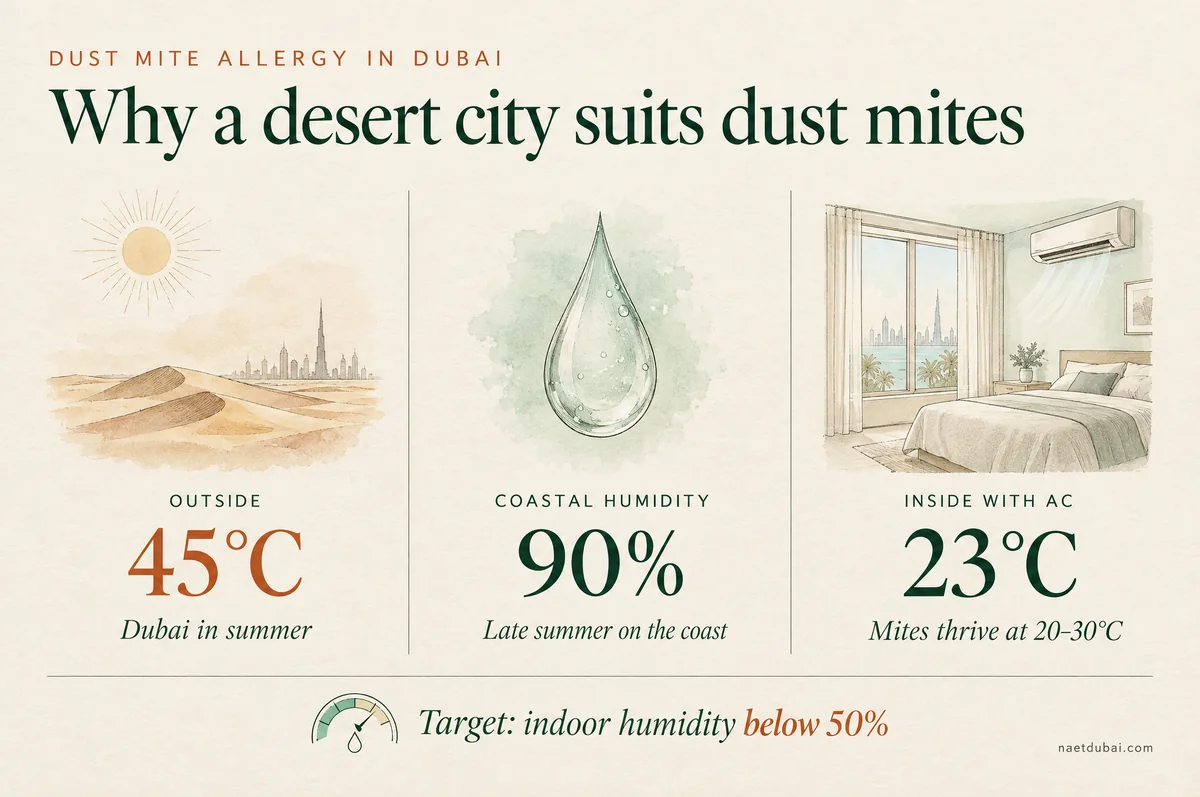
Dust mites thrive between 20 and 30°C, according to research from University College London.
Outside it might be 45°C in August. Inside, the AC keeps us at 22, 23, 24°C, year-round. Indoors, we’ve created their perfect climate.
Our humidity is higher than people think
Dubai is a coastal city. In late summer, the National Centre of Meteorology regularly forecasts humidity of up to 90% in coastal areas, often with fog. If you live in Marina, JLT, the Palm or near the Creek, you’ve seen your windows steam up in the morning.
Researchers studying the Gulf have noted that coastal areas of the Persian Gulf usually exceed 85% relative humidity, which favours dust mites, unlike dry inland cities such as Riyadh.
A 2025 review of 27 studies across the GCC found dust mite sensitisation ranging from 15% to 78%, and named dust mites the region’s primary airborne allergy trigger. The humid coastal cities sit at the top end of that range.
Your body does the rest
This is the part most people miss.
When you lie down at night, your body heat and your breath create a warm, moist little climate inside your mattress and pillow. Eight hours of that, every night.
US research funded by the Environmental Protection Agency found that mites only need a few humid hours a day to survive and breed. The same research found that in homes above 51% humidity, mite numbers went up in humid summers “with or without air conditioning”.
So AC on its own doesn’t solve it. It only helps if it actually dries the air.
What the UAE Numbers Actually Say
There is no large published study measuring dust mite allergy in Dubai alone. But the studies from across the UAE all point the same way.
- Abu Dhabi: In a 2012 multi-country skin prick study, 46% of allergy patients tested in Abu Dhabi were sensitised to dust mites.
- Northern Emirates: A 2025 study in the Saudi Medical Journal of patients from Sharjah, Ajman, Umm Al Quwain and Fujairah found around 4 in 10 reacted to each of the two main dust mite species. That was far ahead of cockroach (13.5%) and cat (11.5%). In children aged 1 to 15 who tested positive, 75% reacted to both mite species.
- Sharjah children: In 180 children tested in Sharjah, dust mites were the number one airborne allergen, ahead of mould, grass and date palm.
- Dubai Hospital: The head of immunology at Dubai Hospital told Gulf News that dust mites accounted for about 30% of the inhalant allergy cases seen at the clinic.
- UAE adults: In a survey of 1,229 adults across the UAE, dust was the number one trigger for allergic rhinitis, named by 59% of sufferers.
Put simply, the house dust mite is the single most common inhalant allergen found in UAE allergy patient data.
It’s Not the Mite. It’s What It Leaves Behind.
Here’s something that surprises a lot of mothers.
We don’t actually react to the dust mite itself. We react to what it excretes.
About 95% of dust mite allergen comes from their droppings. One of the main proteins in those droppings, called Der p 1, is a digestive enzyme. Research in Frontiers in Immunology shows it can disrupt the protective barrier of the skin and the airways.
Your body sees this protein as a threat. It doesn’t happen overnight. It’s the constant, daily contact, night after night, pillow after pillow, until one day the body starts responding.
Signs of Dust Mite Allergy in Your Children (and in You)
From what I’ve seen over the years, when the body reacts, it usually goes one of two ways. It attacks the skin, or it attacks the upper respiratory system. Sometimes both.
Skin symptoms
- Itching when they lie down in bed
- Itching first thing in the morning
- Rashes or hives
- Eczema (atopic dermatitis) flare-ups, often worse at night
Breathing and nose symptoms
- Sneezing, especially in the morning
- Runny or blocked nose that never seems to clear
- Itchy, watery eyes
- A cough at night or on waking
- Wheezing or asthma-type symptoms
Allergy UK lists the same pattern of symptoms. The big clue is when they happen. If your child is fine at school but itchy and sneezy at bedtime and breakfast, look at the bedroom.
Our children are already sensitive
A 2019 survey of 3,436 schoolchildren in Dubai and the Northern Emirates found:
| Condition | Age 6–7 | Age 13–14 |
|---|---|---|
| Allergic rhinitis symptoms | 46.5% | 51.3% |
| Eczema | 12.9% | 14.6% |
| Asthma | 11.9% | 9.8% |
That’s nearly half of our children with nose allergy symptoms. And a 2024 UAE expert consensus found people with allergic rhinitis here were far more likely to have asthma (23.8% versus 7.5%).
Some children tolerate dust mites without a problem. Others, especially those with sensitive skin, simply can’t. Same house, same bed linen, two very different reactions.
Dust Mites vs Sandstorm Dust: Not the Same Thing
In Dubai, when people say “I have a dust allergy”, they often mean two very different things.
Sandstorm dust is fine mineral dust from the desert. It irritates the airways. UAE doctors report more respiratory cases during hot, dusty spells, and these flare-ups come and go with the weather.
Dust mite allergy is a specific immune reaction to proteins indoors, in your bedroom and on your sofa. Mites are nearly absent in arid outdoor conditions, so desert sand isn’t carrying them.
A simple way to tell them apart: sandstorm symptoms usually come in short bursts linked to the weather. Dust mite symptoms tend to be year-round and worse in bed, on waking or while cleaning.
“But Tom, I Wash My Sheets Every Day!”
I know. I’ve heard it so many times.
And yes, washing at 60°C does kill the dust mites in your sheets. Research shows a cooler 35°C wash kills fewer than half of them, so the temperature really matters.
But the mattress, pillow, sofa and curtains are still full of them. The minute you lie down, your body heat creates that humidity again. They have food, they have moisture, and they’re very resilient.
So you can be the cleanest mum in Dubai, and your child can still react. It’s not your fault.
The honest truth is you can’t get rid of dust mites completely. A large Cochrane review of 54 trials found that mite-control measures on their own didn’t improve asthma symptoms. What you can do is lower the load, and combine that with finding out what your body is actually reacting to.
Hypoallergenic bedding: the best place to start
People ask me, “Should I switch to linen? Cotton? Silk?”
It doesn’t matter. Dust mites live happily in any material.
What does help is mite-proof (hypoallergenic) covers for the mattress, pillows and duvet. These are made from very tightly woven or specially treated fabric that stops mites and their droppings getting through. According to the American Academy of Family Physicians, covers combined with hot washing can cut mite allergen exposure 100 to 1,000 times within a month.
A Dubai home checklist for mums
In the bedroom
- Mite-proof covers on mattress, pillows and duvet
- Wash bedding weekly at 60°C
- Replace children’s pillows regularly
- Swap bedroom carpet for tiles or wood if you can
- Keep soft toys to a few favourites. Put them in a bag in the freezer for at least 12 hours once a month, as Allergy UK suggests
- Bunk beds: the allergic child goes on the top bunk, so dust doesn’t fall on them
Humidity and AC
- Buy a cheap hygrometer and check your indoor humidity. Aim for below 50%
- Service your AC before summer and clean or change filters every 1 to 3 months
- If you live in a tower with district cooling (common in JLT and Marina), ask your building management who cleans the fan coil unit and filter inside your flat
- Going away for summer? Don’t switch the AC off. Dubai firms told Khaleej Times mould enquiries jumped by up to 70% one summer, partly from AC being switched off during holidays. They advise setting it to 26–28°C instead
- Keep balcony doors closed on humid nights and during sandstorms
A checklist for your nanny or housekeeper
- Damp-dust surfaces rather than dry dusting
- Vacuum with a HEPA filter vacuum while the allergic child is out of the room
- Wash curtains and cushion covers monthly
- Air the mattress when the weather allows
One thing I’d skip: expensive room air purifiers just for dust mites. Mite particles are heavy and settle quickly, so air purifiers aren’t effective for mite allergen. A Dubai paediatrician told Gulf News they help only “to an extent”.
Getting Tested for Dust Mite Allergy in Dubai
Before you change everything at home, find out what you’re actually reacting to.
The standard tests are:
- Skin prick test, done by an allergy specialist
- Specific IgE blood test for the two main dust mite species (lab codes d1 and d2)
One word of caution. Many home-collection services in Dubai advertise a “total IgE” test. That is a general allergy marker. It does not tell you whether you’re allergic to dust mites. Ask specifically for dust mite (d1 and d2) testing.
If your child also reacts to prawns, mention it. A dust mite protein called tropomyosin can cross-react with shellfish.
Conventional Options, and How We Approach It at NAET Dubai
According to the 2024 UAE expert consensus, the conventional first line is a steroid nasal spray, with antihistamines added as needed. Allergen immunotherapy (tablets or drops under the tongue) is available in the UAE, runs for at least three years, and insurers often reject claims.
These approaches mainly manage symptoms. At NAET Dubai, we look at the bigger picture.
In my experience, dust mites are rarely the only thing going on. An over-reacting immune system usually has other triggers alongside: foods, chemicals, gut health and emotional stress.
- Root-Cause Mapping. The NAET technique and a bioresonance assessment help us look at what your body may be reacting to, alongside any tests from your doctor.
- System Stabilisation. NAET sessions focus on helping the body become less reactive to those triggers.
- Sustained Recovery. Diet guidance and home changes, so the body has the right environment to settle.
We’re a complementary clinic. We work alongside your GP, paediatrician or allergist, never instead of them. Clients often tell us their nights become calmer, but every body is different and we’ll always be honest about what to expect.
The Bottom Line
Dust mites are in every home in Dubai. Yours, mine, everyone’s.
It’s not about how clean you are. It’s about humidity, our love of AC, and how sensitive each body is.
You can’t eliminate dust mites. But you can lower the load, test properly, and work on why the body is over-reacting in the first place.
If your child is itching every night or you’re waking up sneezing every morning, you don’t have to just live with it.
Book an initial consultation at NAET Dubai, JLT or message us on WhatsApp. Let’s find out what’s really going on.
Frequently Asked Questions About Dust Mite Allergy in Dubai
Yes. Dust mites are the most common indoor (inhalant) allergen in UAE allergy studies. Roughly 4 in 10 people tested for allergies in the UAE react to them, including 46% of patients tested in Abu Dhabi (Hasnain et al., 2012) and around 39% in the Northern Emirates (Saudi Medical Journal, 2025).
Dust mites need humidity, not rain. Dubai’s coastal humidity, combined with AC-cooled homes kept at 20–30°C and the moisture from our bodies at night, gives them a perfect indoor climate.
No. Dust mites are in every home, whether it’s a villa or an apartment. They feed on the skin we naturally shed and live in beds, pillows, sofas, carpets and curtains, however often you clean.
Itching when lying down or on waking, eczema flare-ups, hives, sneezing, a runny or blocked nose, itchy watery eyes, night-time coughing and sometimes wheezing. Symptoms are usually worse at bedtime and in the morning.
Dust mite droppings contain proteins that can damage the skin’s protective barrier (Frontiers in Immunology, 2014), and many children with eczema are sensitised to dust mites. In Sharjah, over a fifth of children tested for dust mite allergy had atopic dermatitis (Sharif et al., 2018).
No. Sandstorm dust is mineral dust that irritates the airways in short bursts. Dust mite allergy is an immune reaction to proteins from mites indoors, and it tends to be year-round.
It can, if it isn’t drying the air or isn’t maintained. AC keeps homes at the temperature mites love. If humidity indoors stays above about 50%, mites keep thriving. Keep filters clean, service the unit before summer and don’t switch it off for long periods in humid months.
Below 50%. Below 35% for most of the day stops mites completely, but that’s hard to achieve in Dubai’s summer. A simple hygrometer will tell you where you stand.
60°C. A 35°C wash kills fewer than half of them (US EPA-funded research).
No. Dust mites live in any fabric. What helps is mite-proof (hypoallergenic) covers on the mattress, pillows and duvet.
Not much. Mite allergen particles are heavy and settle quickly, so room air purifiers are not effective for mite allergen specifically (American Academy of Family Physicians).
Ask for a skin prick test or a specific IgE blood test for dust mites (d1 and d2). A “total IgE” test on its own cannot confirm a dust mite allergy.
Possibly. A protein called tropomyosin in dust mites is similar to one in shellfish, and the two can cross-react. Mention it when you get tested.
No. You can reduce them with 60°C washes, mite-proof covers, lower humidity and fewer soft furnishings in the bedroom, but they will always be present in some number.
We take a complementary, whole-body approach. We use the NAET technique and bioresonance to look at what may be triggering the reaction, including dust mites, foods and other environmental factors, then follow up with NAET sessions and practical home and diet guidance. We work alongside your doctor, not instead of them.